SPATIALREHAB
A visionOS companion for early-stage dementia, built on one clinical rule: never let the person feel they got it wrong. Eight short games take a silent cognitive baseline, then the daily exercises rehearse what dementia takes first — making kopi one step at a time, mahjong by the real Singapore rules, and the route home studied on a holographic tabletop before being walked at life size through a neighbourhood meshed from OpenStreetMap. The caregiver dashboard holds the only numbers in the app: one trend line per game, never a grade.
SOURCE ON GITHUB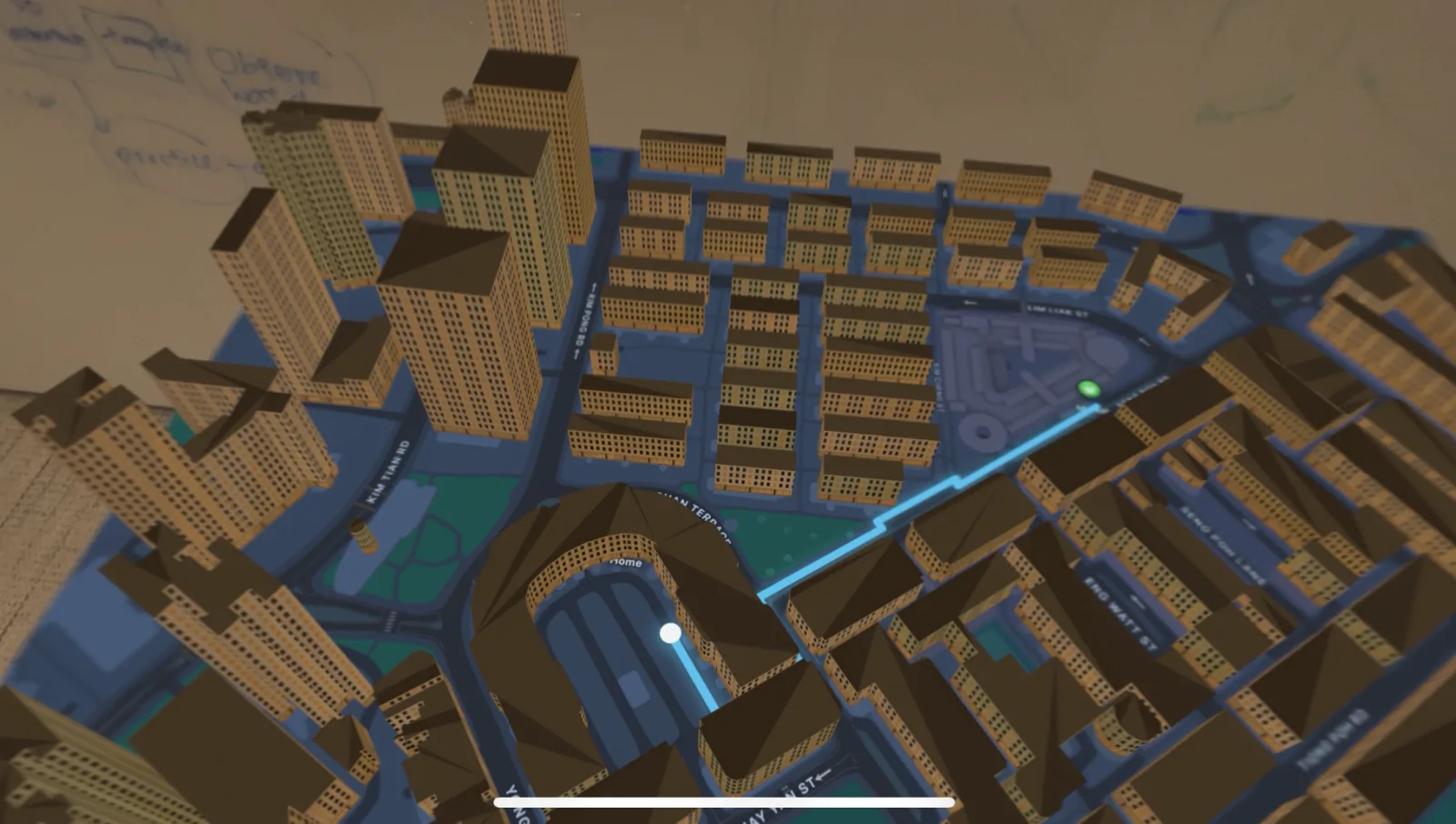 STUDY — THE ROUTE DRAWS ITSELF
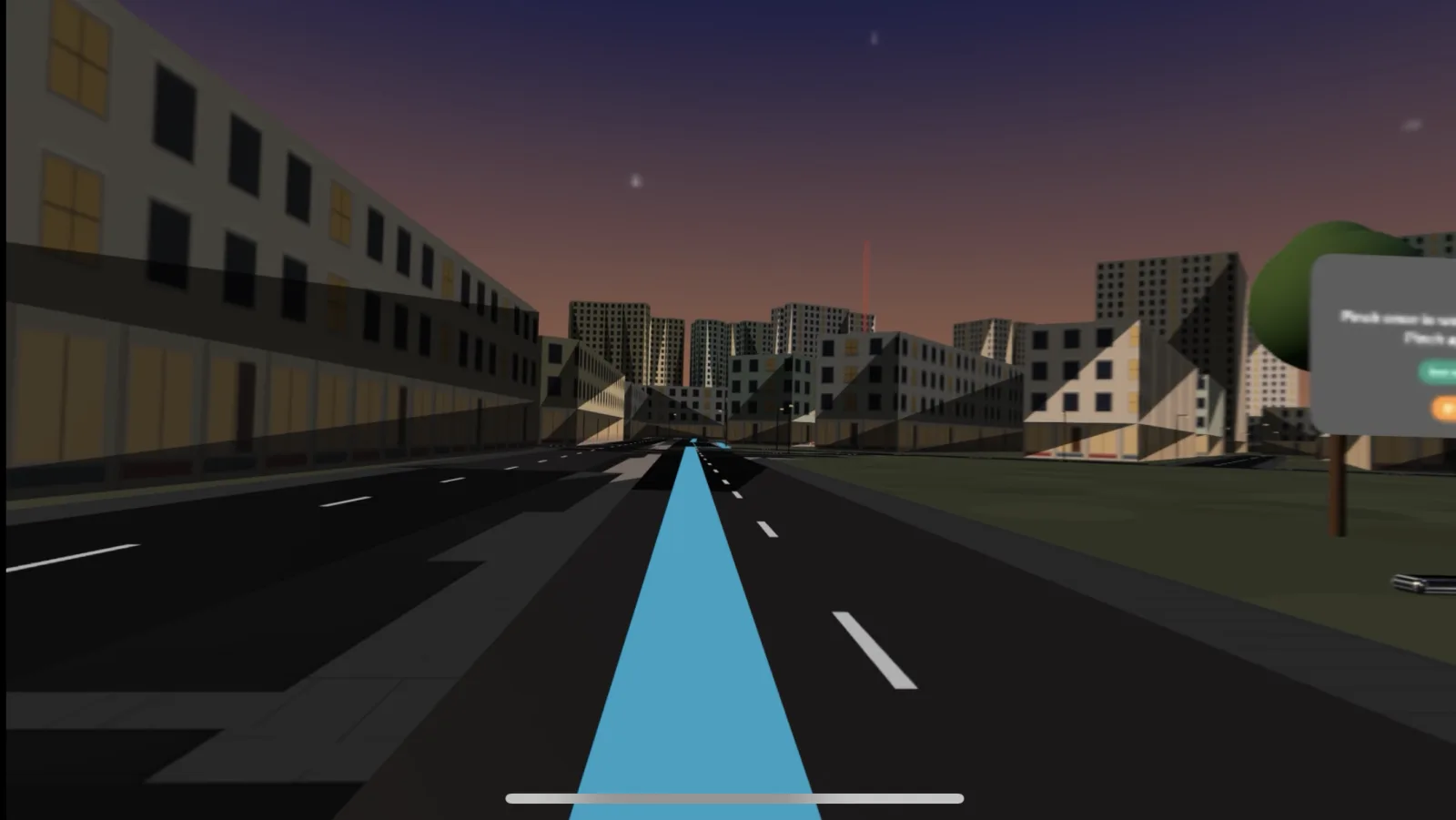 STEP INSIDE — THE SAME ROUTE, LIFE SIZE
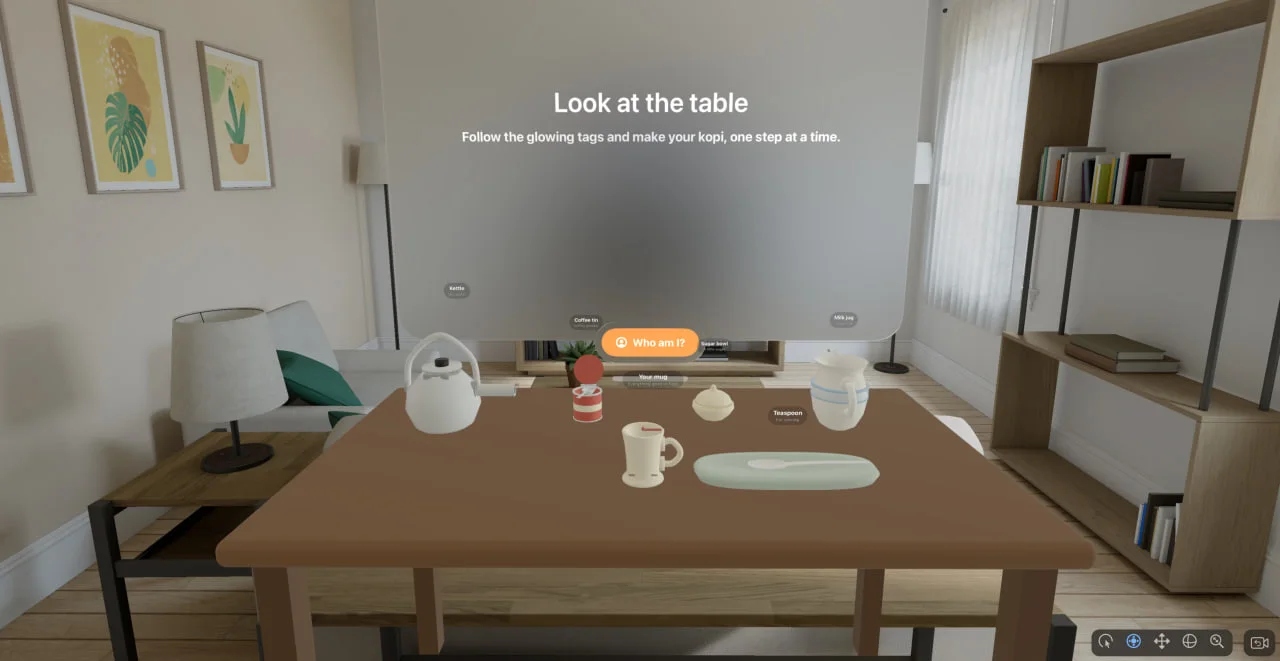 MAKING KOPI — TASK SEQUENCING, HAND TRACKED
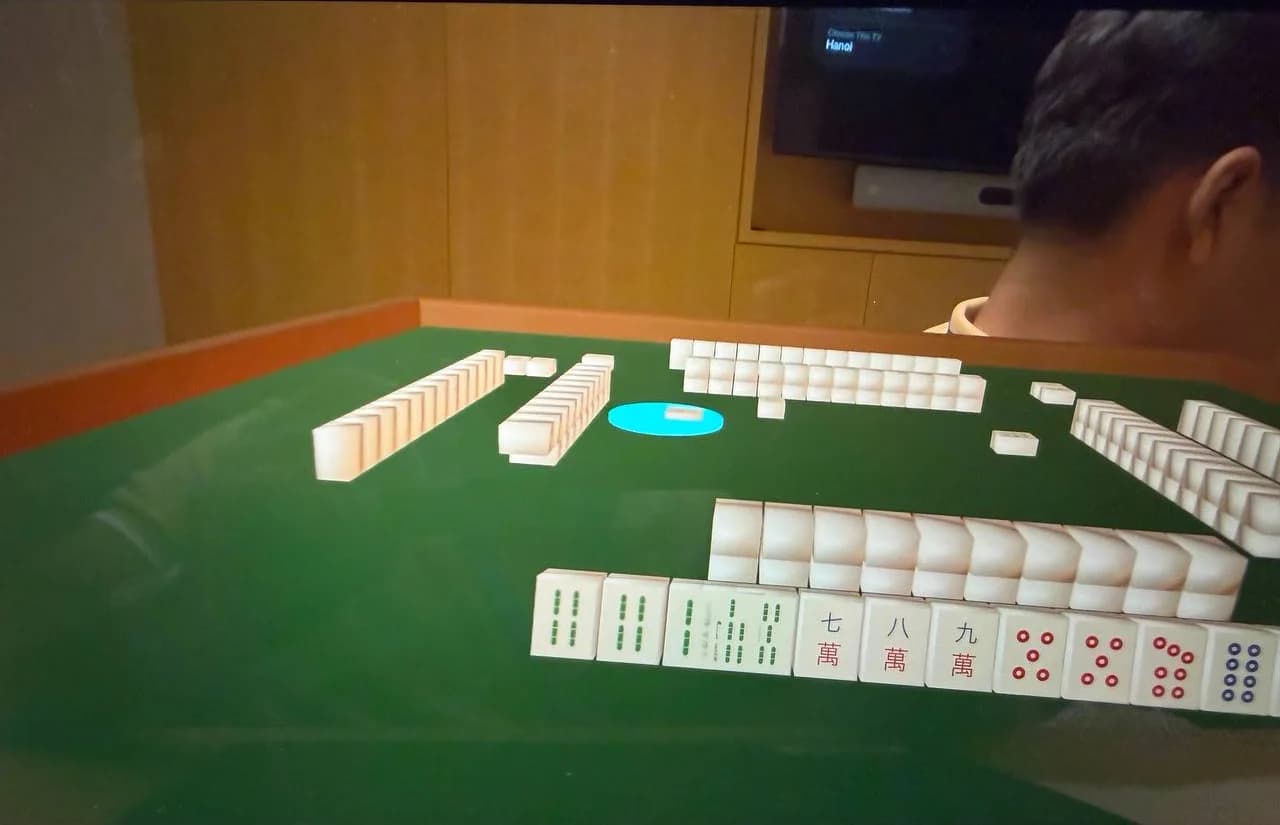 MAHJONG — BY THE REAL RULES
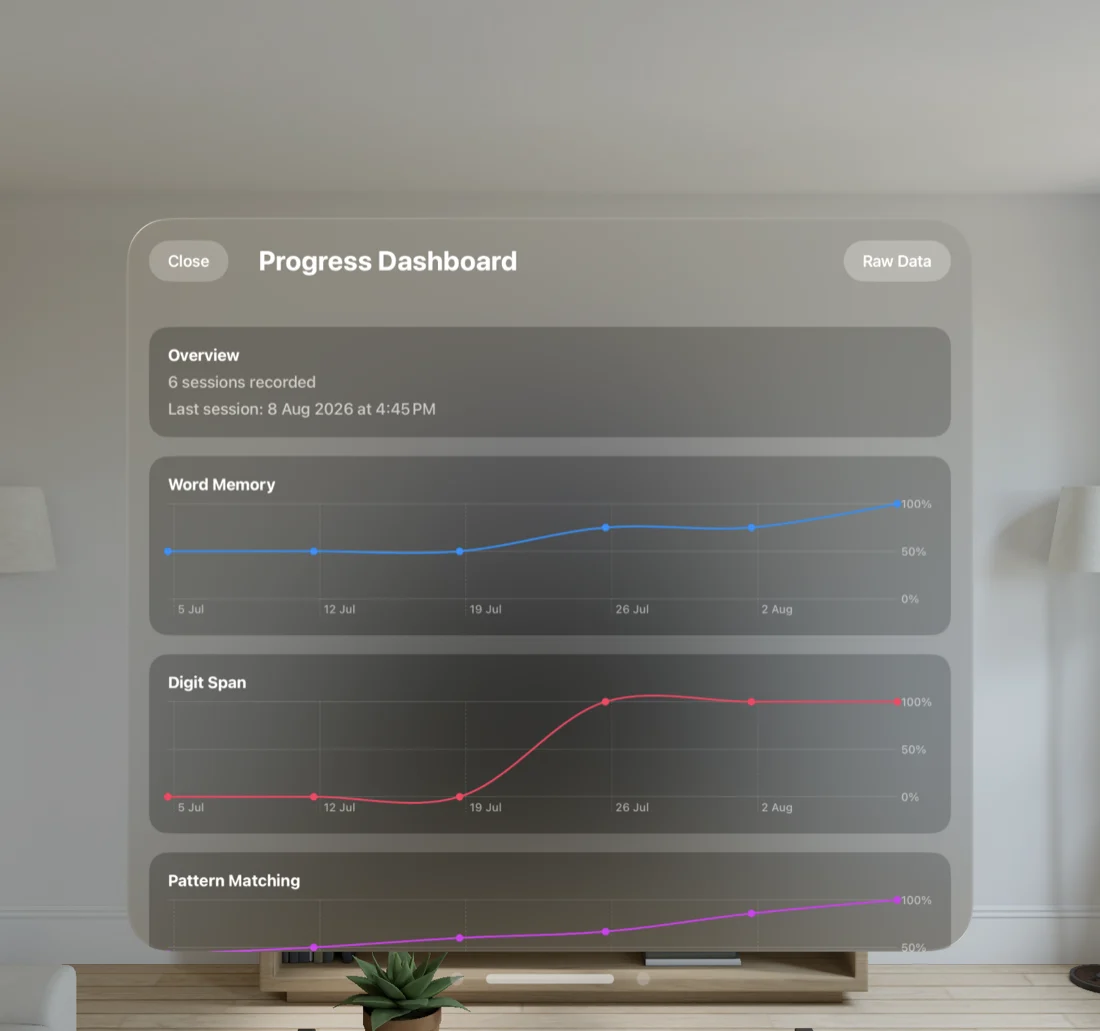 CAREGIVER DASHBOARD — TRENDS, NOT GRADES
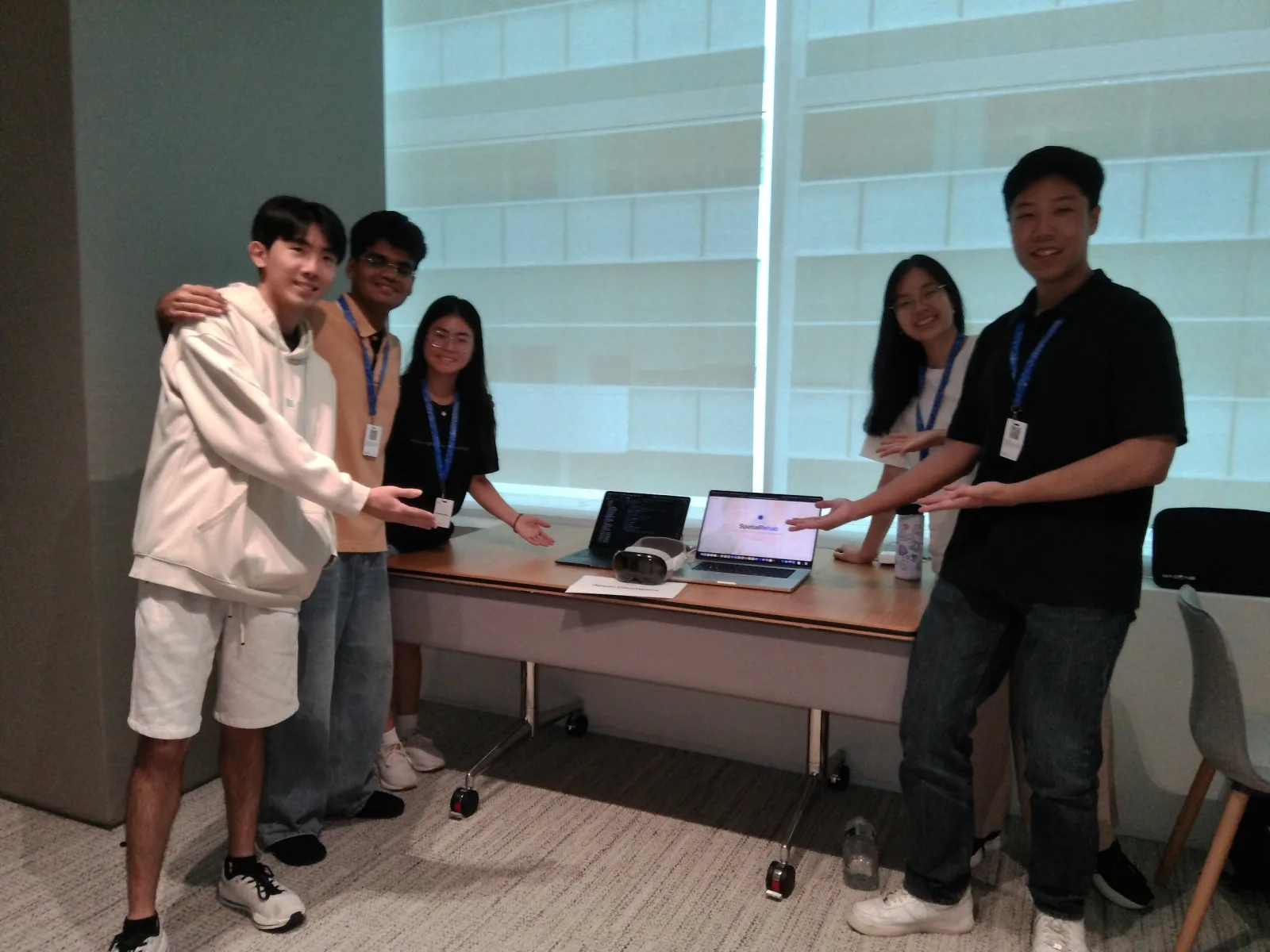 DEMO DAY — APPLE DEVELOPER CENTER, SINGAPORE
A cognitive rehabilitation companion for early-stage dementia, built for Apple Vision Pro over four days at Apple's Spatial Hack AI. Not a diagnostic tool and not a game — a rehearsal space, for a mind and for the route home.
The problem
Dementia takes the everyday first. Long before anything dramatic, the small skills that hold a day together start to fray: the steps of a familiar morning arrive out of order, a walk taken for thirty years stops feeling familiar, and faces stay warm while the names attached to them slip. It is not a small room either — one in eleven Singaporeans over 60 lives with dementia, the projection is 152,000 people by 2030 against about 74,000 in 2023, and 74% of family caregivers say the role overwhelms them.
The one rule everything is checked against
Errorless learning. People with dementia retain procedural memory — the how — far longer than they retain the explicit memory of whether they got it right. Corrective feedback leans on exactly the memory that is failing first, so 'no, try again' teaches the error along with the anxiety of having made it. The alternative is to never let the mistake happen: cue before a wrong answer is possible rather than correcting after one, never show a score or a red mark, and fade the cues gradually across sessions so the ability ends up with the person rather than with the headset.
That rule is load-bearing rather than decorative. A pattern-matching miss just quietly turns back over. The clock-drawing canvas has an unconditional Clear. Wayfinding recall never blocks on a wrong turn. Every game computes a score and none of those numbers ever render anywhere the patient can see them.
What's in it
- A first-run baseline of eight short games — reaction time, orientation, word memory, digit span, pattern matching, trail making, arithmetic and clock drawing — run in a fixed order that opens on the lowest-friction game as a warm-up, each silently scored.
- Making kopi: an activity of daily living practised hand-tracked on a real tabletop, in the order she would actually do it, with the patient choosing up front how much help she wants and every level still ending up offering the full demonstration.
- Mahjong on a proper four-seat table against three computer players, with Pong, Chow and Mahjong claims live on every legal discard. The rules aren't simplified; the deal is — a near-win hand and opponents that feed.
- An identity card one tap away from anywhere — photo, name in English and Chinese, date of birth, address, who to call — built to read as a keepsake rather than a test, plus a family tree of looping portraits that speak a recorded greeting when pinched.
- Remember the Way, the flagship: a real OpenStreetMap extract meshed at runtime into shophouses, road ribbons, street lamps and trees, mounted as a miniature on a holographic tabletop. Study, then trace the route back from memory, then step inside and walk it at life size.
- A caregiver dashboard where every session is appended rather than overwritten — the premise of a baseline collapses if only the most recent run survives.
Walking it without making anyone ill
The life-size walk is the part most likely to go wrong. Locomotion is seated and driven by a single held pinch: velocity eases in and out over roughly 150ms and never varies with how hard the pinch is, small heading changes snap invisibly, and sharp corners take a blink cut rather than a swung camera. There is no stick to steer and no direction to get wrong. Spoken guidance travels the whole way, the arrival is said out loud, and nothing restarts on its own — stopping is only ever letting go.
My slice
Five of us, each owning a distinct piece; mine was AI, analytics and integration. That meant the baseline metrics — what each game measures and how it is scored without any of it reaching the patient — the results store behind them, the caregiver dashboard that turns per-game history into Swift Charts trend lines and a clock-drawing gallery, and the recommendation engine that ranks memory, numeracy and executive function by measured weakness as priority = 1 − score. That last one is a plain weighted comparison rather than a trained model, deliberately: one patient never generates enough sessions to fit anything meaningful, and a caregiver deserves to see exactly why a suggestion came up.
Results
Grand Champion and Best UI/UX at Apple's Spatial Hack AI — first of 126 participants, judged at the Apple Developer Center in Singapore in August 2026. Session length, cadence and programme duration are all pulled from published dementia-intervention findings and Apple's own headset-comfort guidance rather than from what demoed well: 20–30 minutes a session, three or more times a week, over five to eight weeks.
A hackathon prototype, not a medical device. It has not been clinically validated and makes no diagnostic claims. The eight games borrow structure from established concepts such as clock drawing, digit span and orientation; their specific content is still pending clinical review.
18 SLIDES · ARROW KEYS, THE CHEVRONS, OR THE DOTS ALONG THE BOTTOM